bidicalc
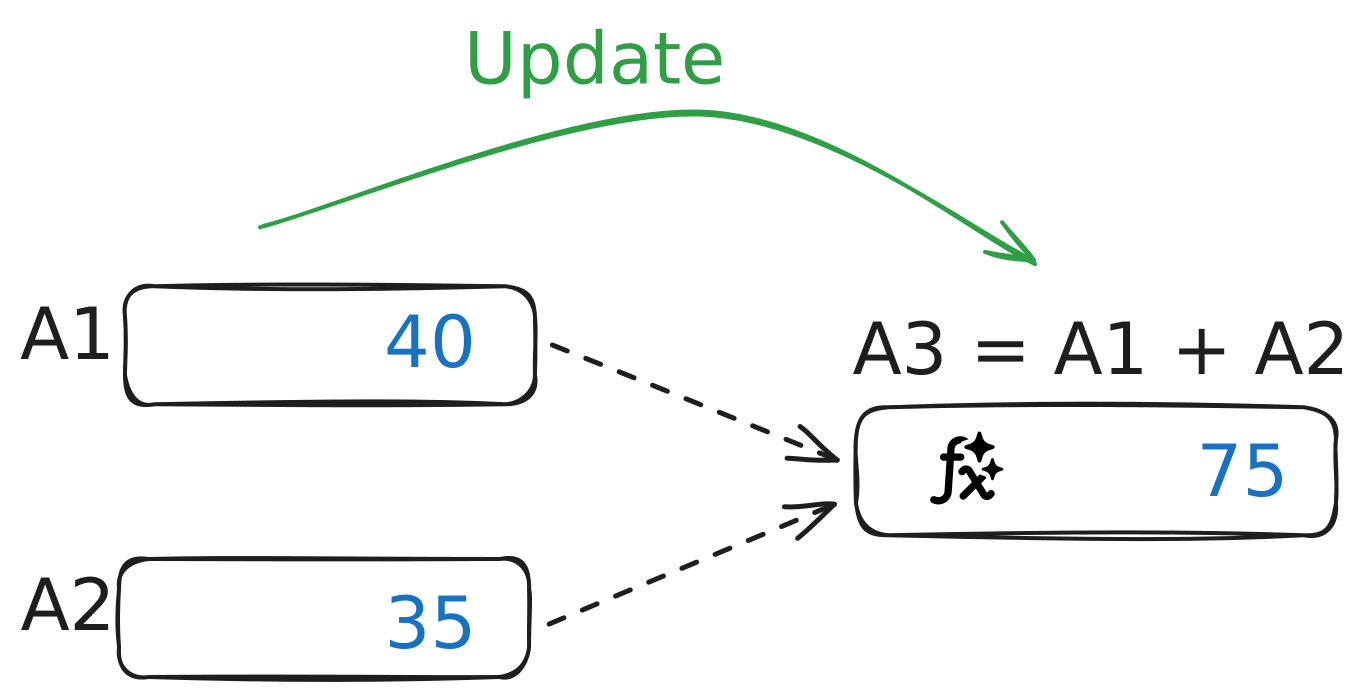
In any normal spreadsheet, when you change values that are the input to some formulas, the outputs are automatically updated:
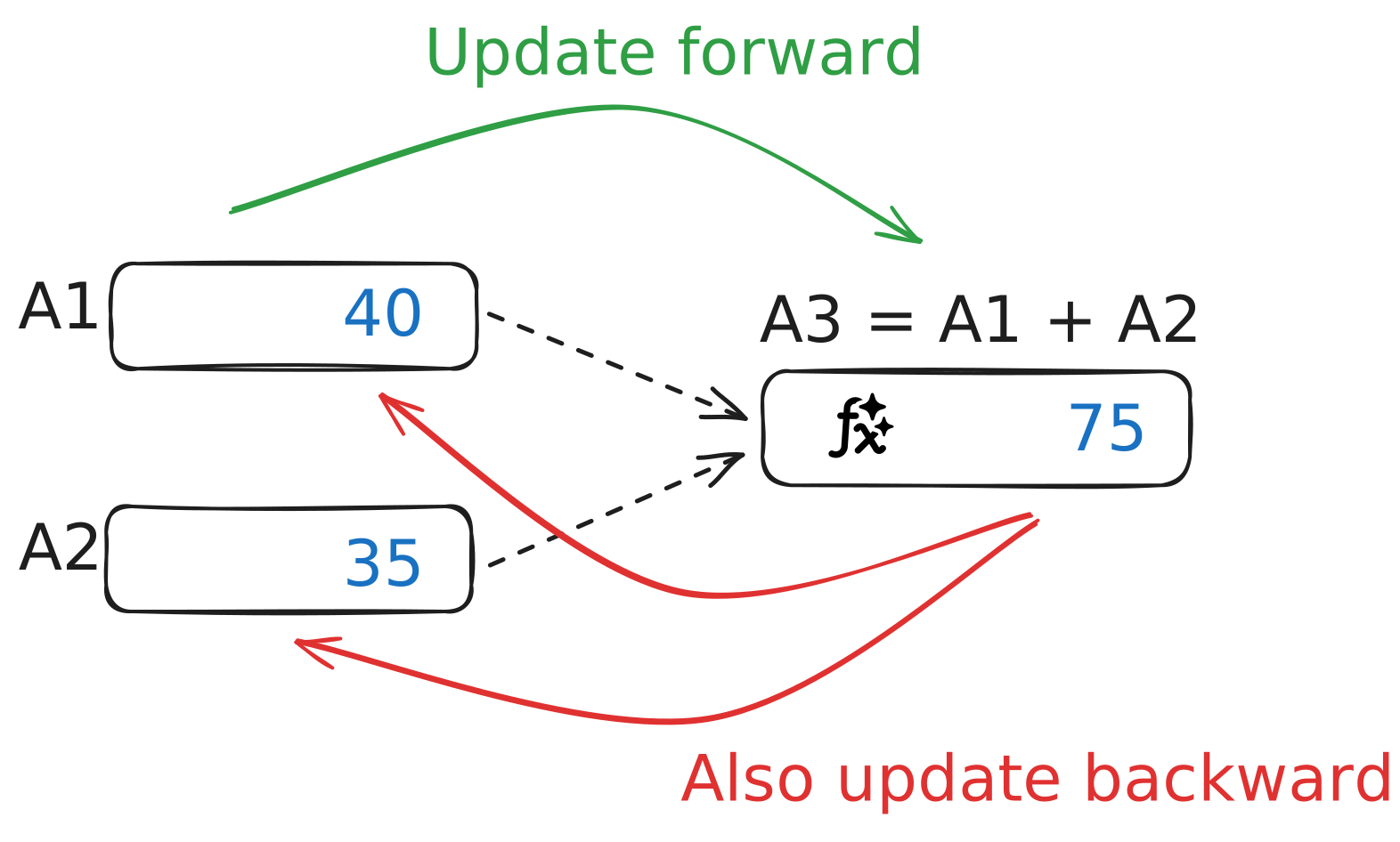
Could it also work the other way? What if you could also change the output, and have the inputs be updated to match the formula?
For the past few months I've been obsessed really curious about this idea. But there were so many questions:
- Would it even be possible at all?
- Could it work with very complex formulas? With exponents? With advanced math functions like
log(),abs(), etc? - How would the UX work? In a normal spreadsheet, when you click on a cell that has a formula, you get to change the formula's expression. I would need a way to let the user change either the formula's expression or the cell's numeric value.
- What should happen if there are multiple possible solutions? Like in the example above, if you set
A3to 100, should the result be 50/50, 20/80, -10000/10100? When there is a infinite number of possible solutions, how to pick one? - Could it work with chained formulas? Could I build a long chain of formulas, update the final value and find the matching inputs all the way backwards?
Ok, now let's just skip to the good part! Today I'm happy to introduce:
User guide
Type of cells
Variables
A simple number entered in a cell is a variable: 1.0. It may be changed by the solver.
Constant
A number prefixed by a hash # is a constant. It will not be changed by the solver.
Text
Cells can be in text mode. To input text, wrap in double quotes: "Distance (km)".
Formula
Formulas can be entered in a cell (the traditional = prefix is optional), for example:
A1 + A2
A1 + A2*(A3 - A1)^2
exp(A1)
#A1 + H5 * #H6
cos(2*pi())
The result of formulas will be automatically updated when an input they depend on changes. This is the usual forward update.
The magic of bidicalc is that once a formula has been computed, you can change the result. Bidicalc will walk "upstream" to change variable cells so that the formula's result matches the change you made. This is the backward update.
TIP
To change a cell formula's expression instead of its result, click on the F icon.
Supported functions
- Arithmetic operators: addition
+, subtraction-, multiplication*, division/, exponentiation^. sqrt(x): square root ofpow(a, b): exponentiation,raised to the power of pi(): theconstant abs(x): absolute value oflog(x)/ln(x): natural logarithm ofexp(x): exponential, the value ofcos(x)/sin(x)/tan(x): cosine / sine / tangent
Keyboard shortcuts
Ctrl + <arrows> - Navigate the gridEnter - Move downShift-Enter - Move upTab - Move rightShift-Tab - Move left
The backwards solver
The solver will try its best to find a solution. However it can fail in different ways:
The solution is incorrect.
This is a bug and should not happen: please report it on GitHub, thank you!The solver reports "no solution", but there is one. This could be a bug in the solver, or you have found a particularly difficult root finding problem that has solutions that are very difficult to find using floating point arithmetic. Please report it on GitHub so I can use it to improve the solver 😃
The solution is technically correct but unexpected.
This can happen for a large class of problems, typically when there are a lot of free variables (the problem is heavily underdetermined) and the solution manifold is weird. For example, try to solvea*b*c = 1to see this in action. To combat this, you can:- Set some variables to constants using the hash syntax, i.e.:
#50. - Reformulate the problem with fewer free variables.
- Wait for me to implement more features like domain restrictions of variables.
- Suggest improvements to the open-source solver on GitHub.
- Set some variables to constants using the hash syntax, i.e.:
DANGER
Keep in mind this is an experiment I made for fun because I like math and spreadsheets. If you need to do root finding to compute the load tolerance of a one milion ton suspended bridge please don't use bidicalc 😄
How does it work?
Even a normal spreadsheet is fairly complex beast. But the novel thing about bidicalc is the backwards solver. Mathematically, updating a spreadsheet "backward" is a (potentially underdetermined) root finding problem, because we are trying to find a vector of unknowns
The actual root-finding solver is a custom algorithm that I made. It a general purpose algorithm that will find one root of any continuous-almost-everywhere function for which a complete syntactic expression is known. It uses a mix of continuous constraint propagation on interval union arithmetic , directional Newton's method and dichotomic search. It is of course limited by floating point precision and available computation time.
Bidicalc is written in TypeScript and entirely open-source under the AGPL licence. This means that you can freely reuse, modify, and share bidicalc as long as you make the complete source code of your modified version available under the same licence. If you are interested in buying bidicalc under a different licence please get in touch.
I haven't taken the time to write a full deep-dive mathematical explanation of how it works, but if you are interested in that please let me know. I might find some time to do it if there is interest from fellow math nerds.
Future improvements
If I kept improving bidicalc until it was perfect I would have never released it. So currently it is imperfect and could be improved in a number of ways.
- Domain restriction for variables. Currently the solver may assign any value in the interval
. I'd like to add special syntax so that variable cells can be restricted by the user to a specific interval. This would allow guiding the solver and saying that you only want this cell to be positive, of to be between 1 and 100, for example. - Solver improvements. The algorithm works well enough for simple problems so I'm happy to publish in this current state, but could always be improved. There are a milion ways to improve it in the future so that it finds better solutions, particularly for highly underdetermined cases.
- float64 gradients support. Due to a pretty obscure technical limitation of tensorflowjs (that I use to compute gradients), the backward solver is partially limited to single precision, even though the forward solver uses double precision via native JS numbers.
- UX improvements. I am not very good at front-end dev 😄. I have learned vuejs to be able to make the UX for bidicalc but I'm not great at it. A spreadsheet interface is actually a massive state machine of complex and subtle behavior, it's a very interesting project and tricky to get right. As you can see, I've decided to skip the usual spreadsheet design principle that cells have two selection states: soft selected which enables dragging, selection, etc. and hard selected which enables changing the content of the cell. bidicalc is simply a CSS grid of
<input>elements. - Move cell computation off the main thread. The solver is single threaded and happens in the UI thread. It should be moved to a web worker to avoid locking the UI.
About me
My name is Victor Poughon, I enjoy math and open-source software. If you want to see me do more stuff like this consider sponsoring me on GitHub or Buying me a coffee.
Thank you ❤️