
python
import numpy as np
import math

for N in range(1, 25):
    m1 = (-math.pi + math.sqrt(math.pi**2 + 4*math.pi*N)) / (2*math.pi)
    m2 = (-math.pi - math.sqrt(math.pi**2 + 4*math.pi*N)) / (2*math.pi)
    print(f"{N: >2} {m1: >6.2f} {m2: >6.2f}")
1 0.25 -1.25
2 0.44 -1.44
3 0.60 -1.60
4 0.73 -1.73
5 0.86 -1.86
6 0.97 -1.97
7 1.07 -2.07
8 1.17 -2.17
9 1.26 -2.26
10 1.35 -2.35
11 1.44 -2.44
12 1.52 -2.52
13 1.59 -2.59
14 1.67 -2.67
15 1.74 -2.74
16 1.81 -2.81
17 1.88 -2.88
18 1.95 -2.95
19 2.01 -3.01
20 2.07 -3.07
21 2.13 -3.13
22 2.19 -3.19
23 2.25 -3.25
24 2.31 -3.31
python
import numpy as np
import math

for N in range(1, 50):
    M = np.floor((-np.pi + math.sqrt(np.pi**2 - 4*np.pi*(1-N))) / (2*np.pi))
    alpha = (N-1)/(math.pi*M*(M+1))
    R = np.arange(1, M+1)
    S = 2*np.pi*alpha*R

    print(N, S)
    print("sum = ", S.sum())
1 []
sum = 0.0
2 []
sum = 0.0
3 []
sum = 0.0
4 []
sum = 0.0
5 []
sum = 0.0
6 []
sum = 0.0
7 []
sum = 0.0
8 [7.]
sum = 7.000000000000001
9 [8.]
sum = 8.0
10 [9.]
sum = 9.0
11 [10.]
sum = 10.0
12 [11.]
sum = 11.0
13 [12.]
sum = 12.0
14 [13.]
sum = 12.999999999999998
15 [14.]
sum = 14.000000000000002
16 [15.]
sum = 15.0
17 [16.]
sum = 16.0
18 [17.]
sum = 17.0
19 [18.]
sum = 18.0
20 [ 6.33333333 12.66666667]
sum = 19.0
21 [ 6.66666667 13.33333333]
sum = 20.0
22 [ 7. 14.]
sum = 21.000000000000004
23 [ 7.33333333 14.66666667]
sum = 22.0
24 [ 7.66666667 15.33333333]
sum = 23.0
25 [ 8. 16.]
sum = 24.0
26 [ 8.33333333 16.66666667]
sum = 25.0
27 [ 8.66666667 17.33333333]
sum = 26.0
28 [ 9. 18.]
sum = 27.0
29 [ 9.33333333 18.66666667]
sum = 27.999999999999996
30 [ 9.66666667 19.33333333]
sum = 29.0
31 [10. 20.]
sum = 30.0
32 [10.33333333 20.66666667]
sum = 31.0
33 [10.66666667 21.33333333]
sum = 32.0
34 [11. 22.]
sum = 33.0
35 [11.33333333 22.66666667]
sum = 34.0
36 [11.66666667 23.33333333]
sum = 35.0
37 [12. 24.]
sum = 36.0
38 [12.33333333 24.66666667]
sum = 37.0
39 [ 6.33333333 12.66666667 19. ]
sum = 38.0
40 [ 6.5 13. 19.5]
sum = 38.99999999999999
41 [ 6.66666667 13.33333333 20. ]
sum = 40.0
42 [ 6.83333333 13.66666667 20.5 ]
sum = 41.0
43 [ 7. 14. 21.]
sum = 42.00000000000001
44 [ 7.16666667 14.33333333 21.5 ]
sum = 43.0
45 [ 7.33333333 14.66666667 22. ]
sum = 44.0
46 [ 7.5 15. 22.5]
sum = 45.0
47 [ 7.66666667 15.33333333 23. ]
sum = 46.0
48 [ 7.83333333 15.66666667 23.5 ]
sum = 47.0
49 [ 8. 16. 24.]
sum = 48.0
/tmp/ipykernel_75931/2490190196.py:6: RuntimeWarning: invalid value encountered in scalar divide
alpha = (N-1)/(math.pi*M*(M+1))
/tmp/ipykernel_75931/2490190196.py:6: RuntimeWarning: divide by zero encountered in scalar divide
alpha = (N-1)/(math.pi*M*(M+1))
python
import numpy as np


def uniform_disk_sampling(N, diameter):
    M = np.floor((-np.pi + np.sqrt(np.pi**2 - 4*np.pi*(1-N))) / (2*np.pi))
    if M == 0:
        M = 1
    alpha = (N-1)/(np.pi*M*(M+1))
    R = np.arange(1, M+1)
    S = 2*np.pi*alpha*R

    # If we're off, subtract the difference from the last element
    S = np.round(S)
    S[-1] -= (S.sum() - (N - 1))
    S = S.astype(int)

    # List of sample points, start with the origin point
    points = [np.zeros((1, 2))]

    for s, r in zip(S, R):
        theta = np.linspace(-np.pi, np.pi, s+1)[:-1]
        radius = r/M * diameter/2
        points.append(np.column_stack((radius*np.cos(theta), radius*np.sin(theta))))

    return np.vstack(points)
python
import matplotlib.pyplot as plt

Ns = [1, 2, 3, 4,
      5, 6, 7, 8,
      19, 20, 38, 39,
      50, 75, 100, 150,
      200, 300, 500, 1000,
      2000, 3000, 5000, 10000]

fig, axes = plt.subplots(6, 4, figsize=(16, 24), dpi=300)

for N, ax in zip(Ns, axes.flatten()):
    ax.set_axis_off()
    ax.set_title(N)
    points = uniform_disk_sampling(N, 1.0)
    ax.add_patch(plt.Circle((0, 0), 0.5, color='grey', fill=False))
    ax.plot(points[:, 0], points[:, 1], marker=".", linestyle="none", markersize=round(6 - np.log10(N)), color="darkred")
    ax.set_xlim([-0.62, 0.62])
    ax.set_ylim([-0.62, 0.62])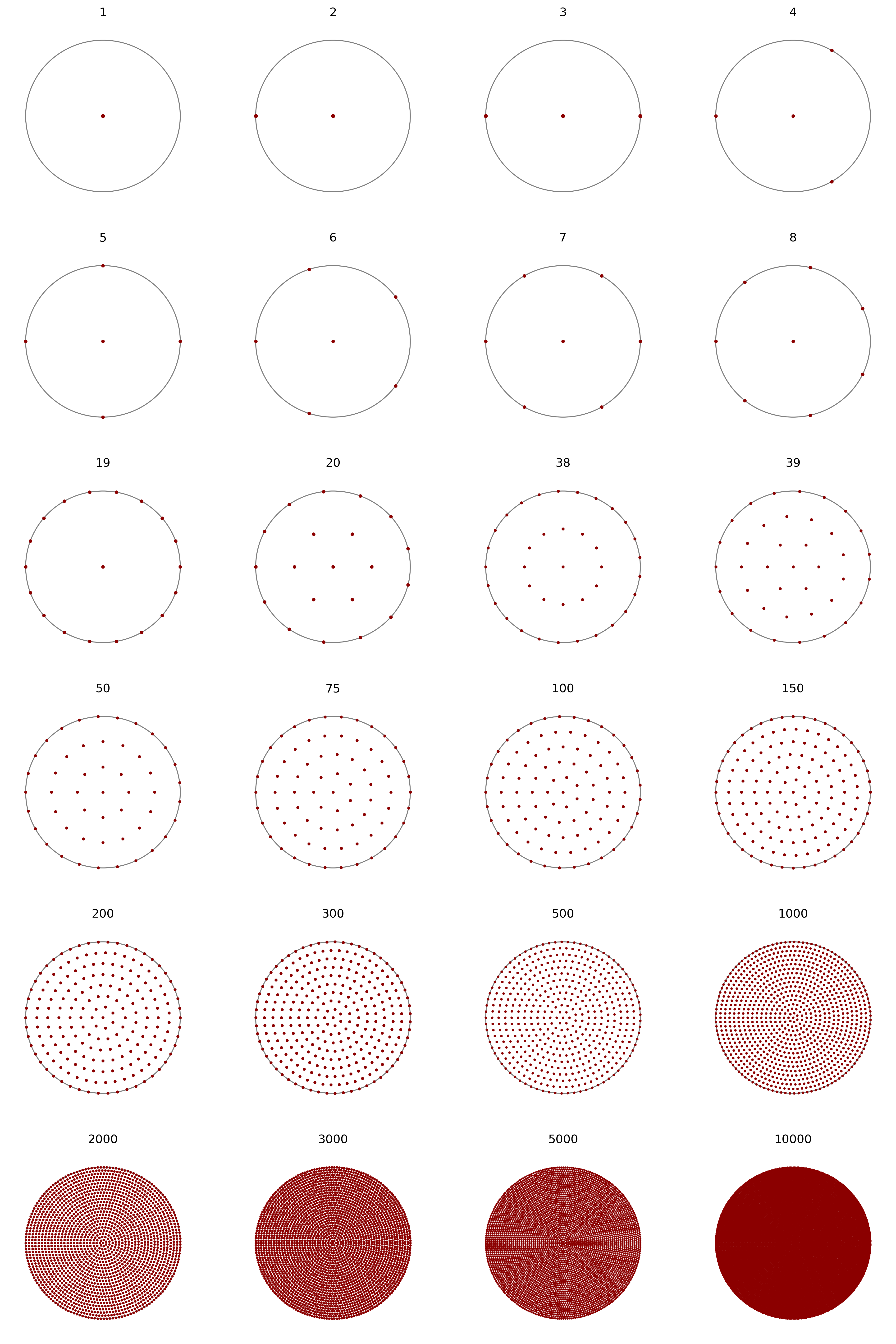
python
import math
import numpy as np

import matplotlib.pyplot as plt

# UniformSampler

def distrib(N):
    """
    Returns an increasing list of integers that sum to N where the first element is always > 1
    N must be >= 7
    """

    M = math.floor((-math.pi + math.sqrt(math.pi**2 + 4*math.pi*N)) / (2*math.pi))

    alpha = N/(math.pi*M*(M+1))
    r = np.arange(1, M+1)
    S = 2*math.pi*alpha*r

    # round to get integer number of points per radius
    S = np.round(S)

    # if we're off by a bit, remove from the last element
    off = S.sum() - N
    S[-1] -= off

    return S.astype(int)


def disk_sample(N, diameter):

    points = [np.zeros((1, 2))]

    S = distrib(N-1)

    print(S)

    M = len(S)
    R = np.arange(1,M+1)

    for s, r in zip(S, R):

        theta = np.linspace(-np.pi, np.pi, s+1)[:-1]

        radius = r/M * diameter  /2

        X = radius*np.cos(theta)
        Y = radius*np.sin(theta)

        points.append(np.column_stack((X, Y)))

    return np.vstack(points)


points = disk_sample(1721, 10.0)

plt.plot(points[:, 0], points[:, 1], marker=".", linestyle="none", markersize=2)
plt.gca().set_aspect("equal")
plt.gca().set_axis_off()
[ 7 14 20 27 34 41 48 54 61 68 75 82 88 95 102 109 116 122
129 136 143 149]